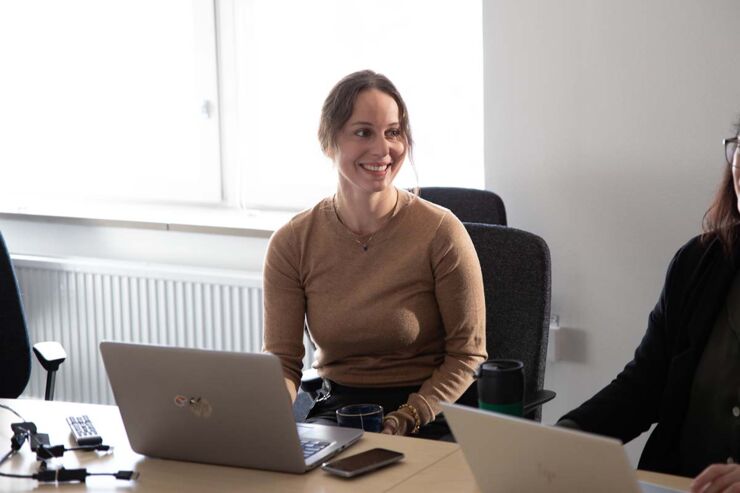
Associate Professor Rebecca Böhme has been named the recipient of the Eric K. Fernström Prize 2025 for young, particularly promising and successful researchers at Linköping University.
Rebecca Böhme, recipient of the Eric K. Fernström Prize 2025 for young, highly promising and successful researchers. (Stock Photo)Photographer: THOR BALKHED
She receives the award for her innovative and impactful research on the mechanisms that shape our sense of self.
-I felt happily surprised and honoured when I received the news that I had been awarded the prize, she says.
“Incredibly motivating for the future”
Rebecca Böhme is associate professor at the Department of Clinical and Experimental Medicine and the Center for Social and Affective Neuroscience, CSAN. She leads the Böhme Lab and her research group aims to understand how the brain and body together shape our perception of the self. To explore how we perceive ourselves, they use behavioural tests, brain imaging, psychopharmacological interventions, and psychophysical methods.
-Knowing that the research my team and I have conducted is being recognized at this competitive level is incredibly motivating for the future, says Rebecca, and continues:
-It encourages me to keep pushing forward, to ask new questions, and to keep building bridges between science, clinical application, and communication with the general public.
What do you think was the key to your success and why did you receive the prize?
Rebecca Böhme during a lab meeting. Photo : John Karlsson (Stock Photo)I believe the prize recognizes not only the scientific quality but also the relevance of our work for patients and clinical practice. The question of how we perceive our sense of self is something that concerns all of us, and it is a key mechanism that needs attention in psychiatric conditions.
How will you continue from now on? -My earlier research laid the foundation by investigating self-disturbances in different populations. Moving forward, I will apply the same perspective to prolonged grief disorder, exploring how we adapt to the experience of loss.
The award committee's motivation:
Rebecca Böhme conducts innovative and successful research on the neural mechanisms that shape our sense of self, specifically how we distinguish between “self” and “others.”
Using functional magnetic resonance imaging of the brain, behavioural measurements, psychopharmacological interventions, and psychophysical methods, she has shown how the distinction between “self” and “others” is disrupted in conditions such as schizophrenia, autism, and ADHD. She also investigates the mechanisms involved in normal grief and prolonged grief disorder.
Rebecca Böhme’s unique research program has generated significant research funding, including an ERC Starting Grant.
This year's award ceremony takes place at “Forskningens dag / Research Day” in Lund on November 5.
SHORT FACTS
Rebecca Böhme
Associate Professor at the Center for Social and Affective Neuroscience (CSAN) and leader of Böhme Lab.
Age: 39 Lives: Brokind Family: My husband, our two sons, four cats, two horses, six chickens and one tortoise. Relaxing with: a horse ride in the forest. Motto: Between stimulus and response there is a space. In that space is our power to choose our response. In our response lies our growth and our freedom. (origin unknown, incorrectly attributed to Viktor Frankl).
The Fernström Prize (Fernströmpriset)
The Eric K. Fernström Foundation was formed in 1978 to promote scientific and medical research.
The primary purpose of the Foundation is to make awards of monetary prizes to researchers who have made outstanding contributions within the medical sciences.
Fernström’s special desire was to stimulate younger researchers. The Foundation therefore makes one award of a Nordic prize and one award to young medical researchers active in Sweden. Each one of Sweden’s medical faculties designates its own prize winner.