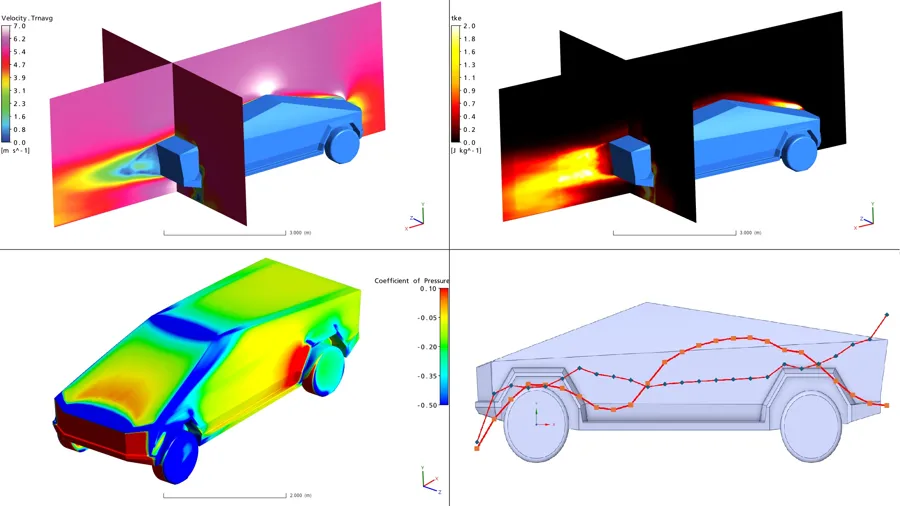
A key area within aeronautical engineering is analysing and understanding how fluid motion and heat transfer interact with the aircraft (both for external and internal flows) and try to explore ways to systematically improve its performance. A vital part of this development process is modelling and simulation using numerical methods like Computational Fluid Dynamics (CFD).
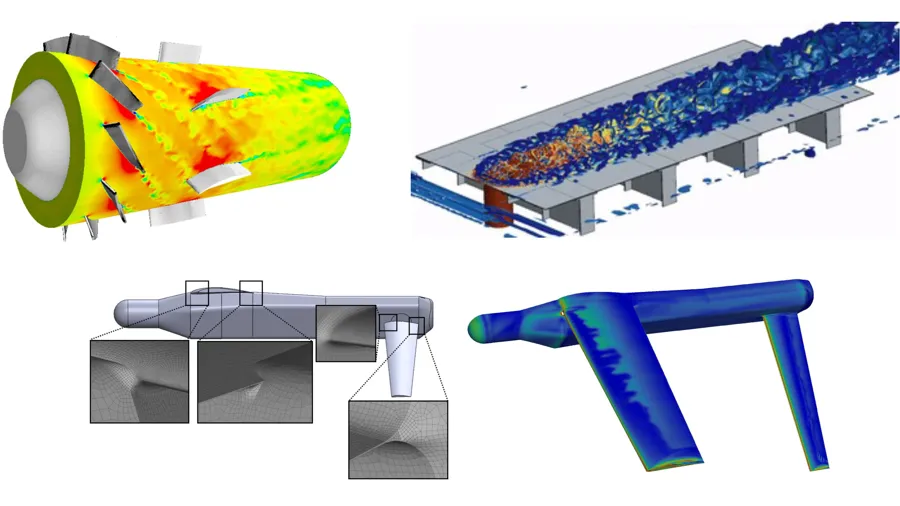
Simulation-based
Technological development has shifted product development toward a highly digital and integrated environment, where expensive experiments increasingly are replaced by simulation-based frameworks. As a result, greater emphasis is placed on the engineer's ability to construct accurate models and interpret simulation results effectively for specific applications. This, in turn, requires a strong grasp of the relevant physical principles and an awareness of the capabilities and limitations/assumptions of simulation tools.
Models and modelling
Within this specialisation you will learn how to assess the reliability your numerical models (i.e.model verification, validation and uncertainty quantification), by adopting these concepts on simpler as well as more advance engineering flow problems. Throughout our CFD course package, you will e.g. learn how to setup of perform low-fidelity (but cost-efficient) steady-state turbulence modelling all the way up to high-fidelity, turbulence resolving methods using local supercomputing resources. Here, you will become familiar with several industrial-relevant tools such as Ansys CFX/Fluent, OpenFOAM, STAR-CCM+, and COMSOL Multiphysics.