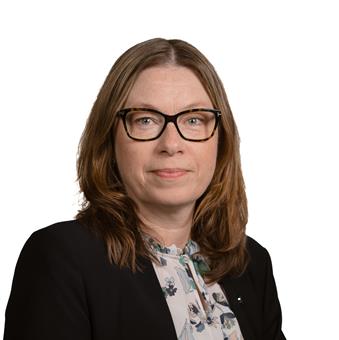
Key areas of my research are knowledge, participation, power, and gender in the design of information technologies. I have primarily studied these issues in the context of the digitization of the public sector, and I am currently involved in two research projects: one dealing with alarm and rescue systems, where I focus on gender issues related to information technologies in this area, and one dealing with smart grids, where we ask critical questions about the potential effects of information technologies in this context.

Johanna Sefyrin
Associate Professor, Head of Division
My research area is broadly defined as the design of information technologies. Design as a collaborative effort to create a world in which there is room for everyone.
Research on knowledge, participation, power, and gender in IT design
My research area is design – in the broad sense – ofinformation technologies, design as a collaborative effort to create a world in which everyone has a place; a social and material practice that takes place in different contexts and at different levels.
Publications
2026
 Terminator eller månadens kollega?: RPA och föreställningar om robots lavar i kommunala förvaltningar
Artificiell intelligens: vad vi kan lära av science fiction 2.0, p. 37-43
(Chapter in book)
The Good Infrastructure: Digital Futures, Values and Friction
AI Infrastructures and Sustainability: Expanding Perspectives on Automation, Communication and Media, p. 341-362
(Chapter in book)
Terminator eller månadens kollega?: RPA och föreställningar om robots lavar i kommunala förvaltningar
Artificiell intelligens: vad vi kan lära av science fiction 2.0, p. 37-43
(Chapter in book)
The Good Infrastructure: Digital Futures, Values and Friction
AI Infrastructures and Sustainability: Expanding Perspectives on Automation, Communication and Media, p. 341-362
(Chapter in book)
 https://dx.doi.org/10.1007/978-3-032-09748-4_16
2025
Sustainable datacentres and eco-modernist frictions in Sweden
Information, Communication and Society
(Article in journal)
https://dx.doi.org/10.1080/1369118X.2025.2596872
2024
RPA and Robot Imaginaries in Swedish Local Government - Terminator or Colleague of the Month?
ELECTRONIC GOVERNMENT, EGOV 2024, p. 270-285
(Conference paper)
https://dx.doi.org/10.1007/978-3-031-70274-7_17
2023
The smart meter as a boundary object-insights from an empirical case
European Conference on Information Systems (ECIS) 2023
(Conference paper)