TellUs - the talking planet

Kids and teachers around a big interactive globe Photographer: Peter Holgersson AB

In the national research and development project TellUs, we explore a visualization globe that combines interactive visualizations and artificial intelligence. By visualizing information and data about the Earth, the globe takes on the role of the planet itself. With the help of an AI model, it simultaneously functions as a conversational partner that pupils can pose questions to. The answers they receive are visual and verbal explanations that open up further exploration.

A Visualization Globe that Allows Children to Explore the Earth

The TellUs project is carried out by a multidisciplinary team consisting of staff from Linköping University and the science center Norrköping Visualization Center C. We develop content and learning activities adapted for pupils in grades 1–6 and work in an outreach-based manner. This means that we bring the globe into children’s classrooms and meet them in their everyday learning environments, creating a close connection between research, teaching, and the children’s own experiences. The globe serves as a shared point of departure for our classroom visits, but our pedagogical approach extends beyond the visit itself. For example, the pupils work on preparatory and follow-up assignments that connect to the visit and ensure the experience is grounded in the classroom and continues to develop there.

Development and Research in Close Proximity to the Target Group

The development of the globe and its content takes place step by step and in close dialogue with students and teachers. Through testing and feedback from schools, we shape the globe’s content and functionality. Working closely with the target group is a central part of the project and crucial to creating learning experiences that connect with what the children are already working on in school. The outreach work also enables us to bring Visualization Center C’s offerings into schools and provide more children with access to the technology and knowledge that are otherwise primarily available at the center.
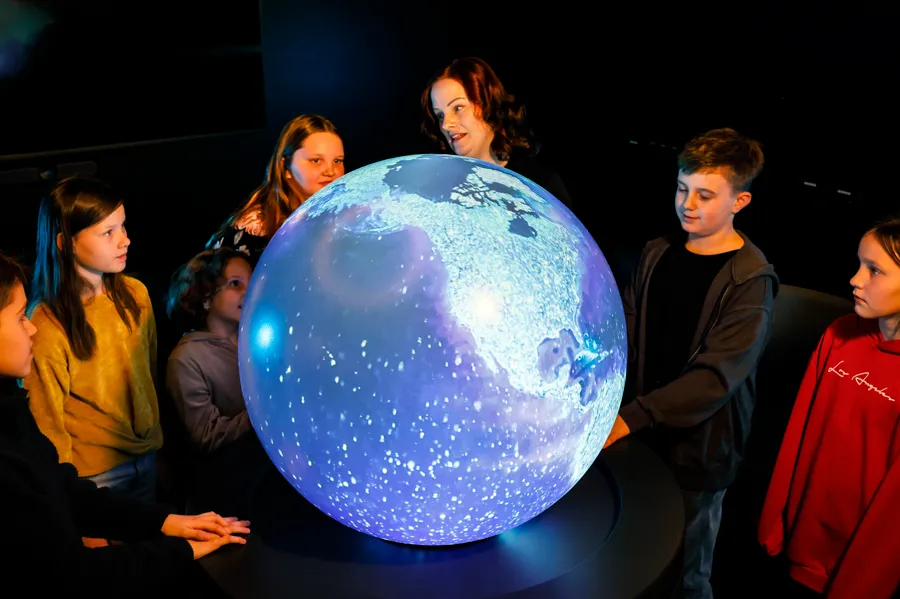
A group of people standing around a large globe. Peter Holgersson AB
The research within the project focuses on visual learning, visual communication, and creative processes in interdisciplinary projects. We investigate, for example, how technical, pedagogical, and narrative aspects can interact in the design of content and classroom visits. In parallel, we study how students experience their encounter with the globe. Through classroom observations, interviews, and student assignments, we analyze how the globe is used, the kinds of questions children raise, and how visual representations and dialogue can support their exploration.

A National Collaboration

TellUs is part of the national WISDOME initiative, a consortium consisting of Visualization Center C in Norrköping, Curiosum in Umeå, Malmö Museum, Universeum in Gothenburg, and Tekniska in Stockholm. The project is led by Linköping University and Visualization Center C in Norrköping. The other science centers within WISDOME participate by using and testing globes in their activities.

Contact

Project Participants at Linköping University

Project publications

Emelie Fälton, Isabelle Strömstedt, Mathis Brossier, Andreas C. Göransson, Konrad Schönborn, Amy Loutfi, Erik Sundén, Mujtaba Fadhil Jawad, Suleiman Yadgar, Johanna Björklund, Mario Romero, Anders Ynnerman, Lonni Besançon (2026)

EuroVis 2026 Education Papers

Organisation

Visualization Center C

Projekt Participants from Norrköping Visualization Center C

Lisa Lindgren, VD, Steering Group Member
Matilda Stafstedt, Science Center Educator
Anton Lilja, Responsible for School Relations
Kristin Blomgren, Communications Officer

Visualization Center C

A research and science centre in Norrköping, Sweden, conducting a unique mix of leading visualisation research and public outreach activities. The centre hosts a large-scale arena for public visits and events.


Visualization Center C

More about research at LiU