A conference of great relevance for additive manufacturing
23 January 2025
Ulrik Svedin
LiU hosted The Swedish academic conference for additive manufacturing of metals in January 2025
Photographer:
Ulrik Svedin
The event mainly focused on academic research of young researchers (PhD students and post docs). It also covered research from industry (SAAB, Siemens and Freemelt) and things to bear in mind when cooperating in research at universities. For example, how to implement the results in an industrial context.
"We are delighted to have gotten the opportunity to organise this annual conference at LiU. The number of participants at the conference was about the same as in previous years. In total there were about 60 participants and about 25 presentations covering many different disciplines involved in AM. It shows that additive manufacturing of metals is still an interesting research area," said Johan Moverare, research leader in additive manufacturing at LiU and organiser of the conference.
Networking
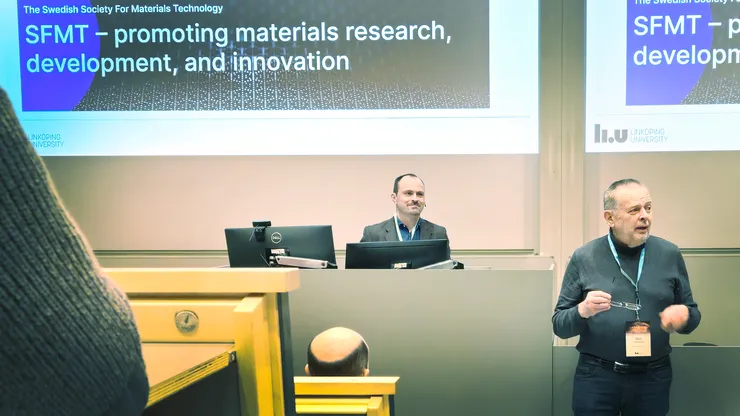
The aim with the conference is reinforce the network of researchers from Sweden within the field of Additive Manufacturing of Metals. The event was supported by The Swedish Society for Materials Technology (SFMT): Professor Johan Moverare and Sten Johansson, Professor Emeritus, chair of SFMT. Photographer: Ulrik Svedin
“SFMT conferences like this is of great relevance to support knowledge transfer between industry, academia and institutes. In this case within metal-AM, and with the final aim of promoting Swedish material competitiveness",
said Sten Johansson, professor emeritus, and chair of SFMT.
"It is also of great importance to support young people from academia and industry with interests in materials technology”, Sten Johansson then added.
Mattias Calmunger, professor and head of the division of Engineering Materials met the participants and noticed the importance of both the presentations and the small talk in between.
"Inspiring"
“It is very inspiring to hear all brilliant researchers presenting interesting results and the discussions followed the presentations and, in the breaks, in between. I am sure the conference will resultin several innovative ideas for new research projects and joint publications based on the lively discussions over the coffee and lunch breaks, and especially at the dinner”, said Mattias Calmunger, professor, and head of the division of Engineering Materials.
Magnus Kallin, Adjunct Associate Professor lecturing at the conference, emphasised the importance of collaboration between industry and academia. Photographer: Ulrik Svedin
Next year´s conference
The materials discussed included Inconel 738, pure copper, Haynes 282, and various titanium and aluminum alloys used in powder bed fusion processes.
A nordic network in additive manufacturing in the future was also discussed during the panel conversation. Next year, this conference will be held at Luleå University of Technology.